The Non-Obvious Trend Report Archive
ePatient 2015:
Fifteen Trends, Graded
In December 2013, Rohit Bhargava and Fard Johnmar published ePatient 2015, naming 15 trends they believed would reshape health care. Eleven years later, we went back through the archive and graded every one, the same way every other edition of the Non-Obvious Trend Report gets a Trend Longevity Rating: from A (it became core infrastructure) down to D (it faded and never proved its worth).
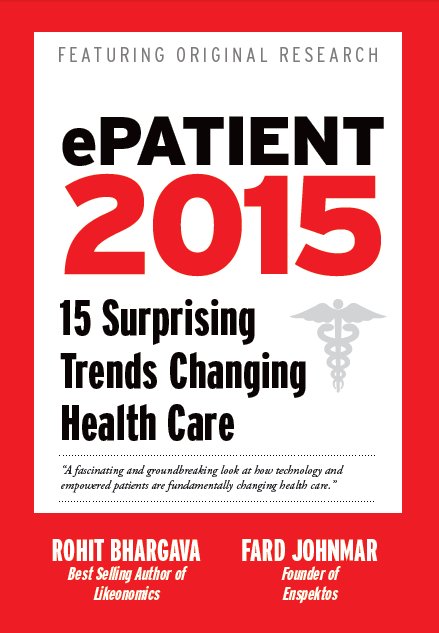
The Story Of The ePatient 2015 Report
The Backstory +
Retrospective
Read eleven years later, ePatient 2015 holds up better than most technology forecasting from its era — not because every detail landed, but because the authors correctly identified the underlying forces (data, empowered patients, and the search for human connection in a cold system) rather than betting everything on specific products. Two patterns stand out across all fifteen chapters. First, nearly every trend proved directionally right and often arrived bigger than predicted, propelled by two accelerants the book couldn't have foreseen in 2013: the COVID-19 pandemic, which forced a decade's worth of telehealth and remote-monitoring adoption into about eighteen months, and the generative-AI boom that began in 2022, which finally gave “empathetic interfaces” and “predictive psychohistory” a technology capable of delivering on the vision. Second, and more sobering: almost every named company the book used as a case study had a rockier fate than the trend it represented. IBM Watson Health was sold at a steep loss. 23andMe went bankrupt after a major data breach. PatientsLikeMe was folded into a conventional insurer. This is a useful lesson in trend-forecasting generally — the forces are usually more durable than the startups riding them. The most understated trend in the book is Unhealthy Surveillance, whose warnings about unregulated health-data brokers read as more urgent in 2026 than in 2013. The most complicated is Natural Medicine, which succeeded so thoroughly it became federal policy, dragging its underlying evidence gaps into the political mainstream along with it. And the biggest gap between promise and practice remains Neuro-Influence Mapping, where the science has advanced faster than its clinical application. Overall, the book's central bet — that health care's future would be shaped less by any single technology and more by empowered, connected, data-literate patients — reads today less like a prediction and more like a description of where health care already is.
Trend Longevity Ratings measure how well each prediction held up. Graded in 2026.
All 15 Trends
The ePatient 2015 Trends
Trend 01 · ePatient 2015
Empathetic Interfaces
Artificial intelligence, improved user interfaces, and wearable devices are coming together to make health technology go beyond the diagnostic to be more empathetic and responsive to emotional needs — in other words, more human.
Graded in 2026
This is the trend the book most undersold. In 2013, "empathetic interfaces" meant a text-message program, a glowing pill cap, and a telepresence robot for readmission prevention. Eleven years later, generative AI chatbots — Woebot, Wysa, and general-purpose assistants like ChatGPT — are a default first stop for millions of people seeking health information and emotional support, and telehealth/remote-patient-monitoring platforms became standard of care after the 2020 pandemic forced adoption at a pace no 2013 forecast anticipated. The book's instinct — that health technology would only work if it felt human rather than clinical — turned out to be the single organizing idea of the next decade of digital health, realized through a technology (large language models) that didn't exist yet when the book was written.
Trend 02 · ePatient 2015
Unhealthy Surveillance
The rapid rise of surveillance technologies that combine clinical and behavioral data to monitor the health of individuals and groups of people presents significant privacy and security concerns. The volume of tools and information being collected vastly outstrips the ability of regulators to prevent misuse.
Graded in 2026
If anything, the book understated this one. The "secondary data players" it warned about — social networks, app makers, and data brokers operating outside HIPAA's reach — are exactly the entities behind the decade’s biggest health-privacy scandals: the wave of period-tracking-app concerns after the 2022 overturning of Roe v. Wade, repeated mobile health app data-sharing exposes, and the 23andMe breach of 2023, which compromised the genetic data of millions and became a multistate legal settlement. The HIPAA "loophole" the authors flagged — that most consumer health apps and wearables simply aren't covered by the law at all — is still, in 2026, the central unresolved regulatory gap in U.S. health privacy.
Trend 03 · ePatient 2015
Predictive Psychohistory
Big Data, powerful computer algorithms, and more are being used to make large- and small-scale predictions about individual and population health. We are entering the age of health psychohistory.
Graded in 2026
The underlying bet — that data-driven prediction would reshape diagnosis and treatment — was correct and, with the rise of clinical machine learning and generative AI since 2022, has gone much further than 2013 predictive analytics could. But the book's flagship example aged badly: IBM Watson, held up here as the poster child of the movement, became one of the decade's most-cited AI failures. IBM sold Watson Health for a fraction of what it had invested in January 2022 after the oncology product failed to deliver reliable, generalizable treatment recommendations. The category was right; the specific bet on a single dominant AI oracle was not — a pattern that recurs throughout this book's case studies.

Trend 04 · ePatient 2015
Augmented Nutrition
Consumers are turning to a range of tools and technologies that provide augmented nutritional information on food products to help them make healthful choices about what they buy and eat.
Graded in 2026
Part of this trend fully arrived: calorie and nutrition labeling on restaurant menus is now standard and legally required across major U.S. chains, and food-scanning apps (Yuka and similar tools succeeded Fooducate as category leaders) are mainstream. But the app-driven, real-time "augmented nutrition" vision — where a smartphone becomes the primary tool people use to control what they eat — was largely overtaken by a development the book couldn't have anticipated: GLP-1 weight-loss drugs like Ozempic and Wegovy, which reshaped the cultural conversation about food control far more than any nutrition app did. The knowledge-and-control instinct behind this trend was right; the delivery mechanism the book bet on was not the one that ended up mattering most.
Trend 05 · ePatient 2015
Medical Genealogy
Genomics and advances in digital genealogy will combine, allowing patients to use their ancestral and genetic history to predict the risk of disease and how they may respond to medications.
Graded in 2026
The science landed almost exactly as predicted: whole-genome sequencing costs fell well below the book's $1,000 target, direct-to-consumer genetic testing became routine, and pharmacogenomics is now a real part of prescribing. But the trend's own case study became a cautionary tale rather than a triumph. 23andMe — the company the book used to illustrate the personal-genomics revolution — suffered a major data breach in 2023 and filed for bankruptcy in 2025, with its genetic database becoming exactly the kind of sensitive asset the book's own "Unhealthy Surveillance" chapter warned about. Medical genealogy as a scientific capability succeeded; medical genealogy as a consumer business model did not.
Trend 06 · ePatient 2015
The Over-Quantified Self
As the volume of clinical and health data increases, consumers will struggle to make sense of the flood of information they produce. Some may ignore this data; others might look for ways to simplify it, while the rest will turn to trusted medical intermediaries for assistance.
Graded in 2026
Wearables didn't just persist — they multiplied. The Apple Watch, Oura Ring, WHOOP, and continuous glucose monitors marketed to people without diabetes have made self-tracking dramatically more mainstream than the Fitbit-era devices the book describes. And the specific worry it raised — that data without interpretation is just noise — proved durable enough that fixing it became the industry's central design problem for a decade, addressed only recently as AI-generated coaching summaries (on Apple Watch, WHOOP, and Oura) finally started doing what Jody Ranck told the authors in 2013 the industry still couldn't: turning numbers into advice.
Trend 07 · ePatient 2015
The Device Divide
Today, the 'digital divide' separates those who can access the latest digital tools from those who cannot. In digital health, we face a 'Device Divide' — economic disparities that may prevent patients, providers, hospitals, and clinics from accessing the latest technological innovations.
Graded in 2026
The specific gap the book measured — slow EHR adoption in low-income and minority communities — has largely closed; U.S. hospital EHR adoption is now near-universal, driven by the same federal incentive programs the book described. But the divide didn't disappear, it relocated. The pandemic-era shift to telehealth exposed a broadband- and device-access gap that mapped onto the same populations the book flagged as underserved, and the current frontier — access to AI-assisted diagnostics and remote monitoring — is showing early signs of the same pattern. The book's core warning, that health technology's benefits reliably reach the privileged first, held up; the specific technology in question kept changing.

Trend 08 · ePatient 2015
Multicultural Misalignment
Digital health technologies will be less effective if they are not optimized, or personalized, to account for differences in gender, age, culture, ethnicity, knowledge, literacy, and more.
Graded in 2026
The book's warning was vindicated by hard evidence it couldn't have cited yet — most notably a widely reported 2019 study showing a major U.S. health-risk algorithm systematically underestimated Black patients' needs, and the well-documented racial bias in pulse oximeters that became a public issue during the COVID-19 pandemic. But the corporate response the book anticipated — sustained investment in diversifying health-tech leadership and design — has not followed a straight line. The DEI initiatives that expanded through the late 2010s and early 2020s have faced significant rollback since 2023, including at a policy level following the 2025 change in federal administration. The diagnosis was accurate; the fix the authors hoped for has been inconsistent.

Trend 09 · ePatient 2015
Healthy Real Estate
Traditionally, people make choices about where they will live based on educational factors and a range of other amenities. In the future, more will use health and wellness criteria such as walkable communities, access to organic and local food sources, and hospital ratings to determine where they should buy or rent a home.
Graded in 2026
This trend has become thoroughly mainstream. The WELL Building Standard the book cites as a fringe experiment is now a globally recognized certification used across thousands of commercial and residential projects, Walk Score is a standard field on real-estate listing sites like Zillow and Redfin, and the post-pandemic surge in demand for home air quality, natural light, and outdoor access accelerated exactly the shift the book described. If anything, "healthy real estate" undersold how central wellness criteria would become to how — and where — people choose to live.
Trend 10 · ePatient 2015
Neuro-Influence Mapping
Advances in brain imaging technology offer new insights into patients' behavioral profiles to support the development of unique, personalized treatment programs that factor in which method of influence may be most likely to work. Marketers are also using brain-mapping technologies for advertising purposes.
Graded in 2026
The research infrastructure the book describes kept expanding — the federal BRAIN Initiative it profiles remained a major, well-funded program through the 2020s, and brain-computer interfaces advanced dramatically, including the first human Neuralink implants in 2024. But the specific clinical promise — using brain scans to personalize mental-health treatment at the bedside — remains more research ambition than everyday practice in 2026; precision psychiatry guided by neuroimaging has not yet reached routine care. Neuromarketing, the trend's other half, stayed a niche specialty rather than a mainstream advertising tool. The science advanced; the two applications the book bet on haven't caught up to it yet.

Trend 11 · ePatient 2015
Natural Medicine
Long called 'alternative' medicine in a dismissive way by some health professionals, new science will continue to prove old beliefs about the value of spices, tonics, and herbs. The result will be more mainstream credibility for natural remedies that were once disbelievingly called 'miracle cures.'
Graded in 2026
This trend not only endured, it became more powerful than the book could have anticipated. Turmeric and other supplements the book cites remain a multibillion-dollar category, integrative and functional medicine are now offered by major health systems, and — most strikingly — natural and alternative health philosophy reached the top of U.S. federal health policy with Robert F. Kennedy Jr.'s appointment as HHS Secretary in 2025 and the "Make America Healthy Again" agenda, which elevated supplements and skepticism of conventional medicine to a governing platform. The book's prediction of "more mainstream credibility" was correct; it likely didn't anticipate how politically consequential that credibility would become, nor the extent to which mainstream medicine's evidentiary concerns about many CAM therapies remain valid and unresolved.
Trend 12 · ePatient 2015
MicroHealth Rewards
Inspired by U.S. federal legislation and a deeper understanding of behavioral science, insurers, corporations, health providers, and others will apply game theory to encourage people to adopt and sustain healthy behaviors by offering them tangible rewards — or punishments — as incentives.
Graded in 2026
This is the trend that aged worst, and the book itself predicted why. Workplace wellness incentive programs persisted through the 2010s and 2020s — insurer point-and-perks apps and ACA-authorized premium discounts still exist — but the evidence for their effectiveness never materialized. A large, rigorously designed 2019 workplace-wellness study out of Illinois found no significant effect on health outcomes or medical spending after a year, echoing the skepticism the book's own sources (RAND, and critics like Bonnie Henry and Michael Fergusson) voiced back in 2013. The gamification impulse survived mostly in diluted form — closing your Apple Watch activity rings — rather than as the rewards economy the chapter envisioned.
Trend 13 · ePatient 2015
Virtual Counseling
People are using online tools to seek and forge one-on-one relationships and offer virtual logistical and emotional support. This can include helping others navigate the new health-insurance landscape, 'sponsoring,' or counseling one another and providing unique knowledge about conditions, ailments, and caregiving.
Graded in 2026
Peer support communities like the ones the book profiles (Postpartum Progress, Crohnology, Smart Patients) proliferated across Reddit, Facebook groups, and dedicated platforms through the 2010s. But the biggest development the book didn't foresee is that virtual counseling would eventually be delivered by AI rather than only by peers — mental-health chatbots and general-purpose AI assistants became a widely used, and increasingly controversial, source of emotional support by the mid-2020s, prompting new safety concerns (including wrongful-death lawsuits tied to AI chatbot conversations in 2024–2025) that a book about human-to-human peer support had no way to anticipate.
Trend 14 · ePatient 2015
CareHacking
As patient health data becomes more widely available and the number of caregivers managing medical care for family members increases, digitally savvy health consumers will leverage the information they gain from doctors, the Web, and other sources to better 'hack' the health system.
Graded in 2026
Patient access to health data expanded significantly beyond what the book describes, reinforced by the 21st Century Cures Act's 2016 information-blocking rules and near-universal adoption of patient portals like MyChart. ZocDoc, one of the book's featured examples, remains a leading appointment-booking platform. But GoFundMe, presented here as a hopeful example of people "hacking" around high medical costs, is viewed far more critically today: medical crowdfunding has grown into a multibillion-dollar shadow safety net, now widely discussed by researchers and journalists as a symptom of health-system failure rather than an innovation to celebrate. Access to data and self-advocacy grew as predicted; the funding workaround the book cited approvingly has aged into a warning sign.
Trend 15 · ePatient 2015
Accelerated Trial-Sourcing
Consumers with chronic diseases and other conditions are pioneering the Accelerated Trial-Sourcing movement as they use digital tools to find one another, complete the first stage of discovery to prepare for a clinical study in real time, and recruit/entice the right pharmaceutical firms or other researchers to conduct the research.
Graded in 2026
Decentralized and patient-centered clinical trials became mainstream, accelerated further by pandemic-era necessity and formalized in FDA guidance on decentralized trials in the 2020s; real-world evidence generated outside traditional trial settings is now formally used in the FDA approval process. But PatientsLikeMe, the book's central example of patient-led research, lost its independence in 2019 when the Trump administration forced a sale away from its Chinese investor, landing the platform inside UnitedHealth Group — one of the country's largest traditional insurers, and an odd ending for a company built on the promise of patients bypassing institutional gatekeepers. The movement succeeded; its flagship symbol was absorbed by the establishment it was founded to challenge.

Want To Use These Trends?
Book A Trend Keynote Or Workshop!
Bring this trend and more to your group with a customized keynote presentation or workshop session with Rohit Bhargava. Non-Obvious Thinkers win the future. Let’s explore how we can help you do this for yourself.
Learn More & Check Availability