The Myth of Sober October and the Coming AI Assistant War
What’s In This Issue?
 Story 01Sober October and Seeing the Trend Within the Trend
 Story 02What the Black Card and the Cornell 7 Can Teach Us About Standing Up For What Is Right
 Story 03Welcome to the AI Assistant War Where Help Might Become Impossible To Avoid
 Story 04Credosynthesis
Even More Stories
- Can Toys R Us Make A Comeback With Short Term Popup Stores?
- The AI Tamagotchis are coming
- How we could save the planet by raising the standard temperature of our freezers
- One startup saving coastlines in Maldives and Miami by designing artificial reefs by working with nature
- One way to restore trust in elections is to show people how they actually work through videos
- Despite Bezos Ownership, Washington Post Releases Impact Report to Show They Aren't as Editorially Compromised As You Think
- Tinder now offers group hangouts as an alternative to one-on-one dates
Sober October and Seeing the Trend Within the Trend
The idea is pretty simple: take a month off from drinking alcohol. For a few years now, the rise of non-alcoholic drinks has been forecasted as a slump for the alcohol industry. Trend reports declaring that Gen Z is drinking less have usually focused on how the younger generation has figured out the health risks, enjoy alcohol less and have created their own traditions to avoid alcohol - like Dry January or Sober October. The truth, though, may be more interesting and nuanced. Consider this report from a recent Nielsen survey:
"93% of nonalcoholic buyers also purchase alcohol. In bars and restaurants, 47% of consumers mix alcoholic and nonalcoholic choices during the same occasion, a practice sometimes called "zebra striping." Nonalcoholic beer, wine and spirits have now reached $925 million in U.S. off-premise sales, up 21.9% from the previous year."
There is an opportunity in non-alcoholic beverages that most of these stories rarely focus on. Let's call it the "one more drink" phenomenon. Those nights when you want to stay out, but have already had a drink or two (or more!) and now you need to slow down. So you turn to the non-alcoholic option ... and you stay at the party for longer.
This is a perfect example of the sort of insight that can come from seeking the trend within the trend. On the surface, it seems like people are drinking less and so the entire alcohol industry and those that partner with it (such as restaurants and bars) would be in jeopardy. When you dig deeper, you can see the one-more-drink opportunity and cater towards that instead.
What the Black Card and the Cornell 7 Can Teach Us About Standing Up For What Is Right
This past week the Romanian Football Federation became the first in the world to announce a black card in U7-U16 soccer games, given to misbehaving parents and spectators who start to disrupt a match. The card covers "insults, abusive language, conflicts, hitting or pushing children, players, coaches, referees, officials, or other spectators." Rather than just being another punishment that requires the offending parent to leave the match, after multiple warnings the issuance of a black card will immediately end the match.
This is more than an individual punishment. There is a social pressure and cost attached to misbehavior. You aren't just acting alone anymore, you are affecting the outcome for everyone else and as a result other parents and spectators will take more ownership of shutting down this unruly behavior which is really the outcome everyone wants.
To stretch this point a bit, there are some parallels with the need for this to the disturbing facts released so far in the story of the Cornell 7 case where a group of fraternity brothers are accused of gang raping a victim back in 2024 and celebrating in a group chat while 57 other brothers saw the chat and chose to do nothing.
At the time the DA refused to bring criminal charges and the fraternity brothers were given minimal punishments. Now the DA is reopening the case, one of the named students has already lost his job, celebrities are speaking out and there is even an entire website dedicated to the case.
The accountability for who is speaking up (and who isn't) is making a difference. Just as the Black card may inspire bystanders to step in and help curb unruly behavior on the sidelines of youth sports, all this public outrage and shame pointed toward those 57 bystanders is inspiring many men about what they would or should do if faced with a similar moment.
Welcome to the AI Assistant War Where Help Might Become Impossible To Avoid
YouTube creator has tools to help you optimize your videos. Kroger has an AI grocery shopping assistant. DoorDash has an AI bot that can "order the usual." Instagram is adding an AI assistant to teach you how to post better. Meanwhile, apps like Instinct, Boardy and Haven are getting a lot of attention as personal assistant bots that can help accomplish a variety of tasks on your behalf from answering emails to making introductions. We are headed toward an AI assistant war where every tool you use and every interaction will be infused with help ... whether you want it or not. There is some precedence for this.
Microsoft introduced clippy back in the early days of Microsoft Office and he was pretty universally hated for popping up unwanted in every situation. Now AI will give us a modern and perhaps more annoying version in every interaction.
Credosynthesis
"Gen Z self identifies as the most religious generation in America," according to a new study from The Harris Poll. (Download Full Report - PDF) Thirty-three percent of Gen Z respondents to a survey described themselves as "religious," followed by 22% of Gen X adults, 19% of millennials and 18% of boomers. On the surface, this conclusion may seem surprising as the assumption often is that each new generation gets less religious than the one that came before. The interesting thing about this conclusion is what being religious actually means to this younger generation.
"Eighty-eight percent of Gen Z adults said they regularly engaged in at least one of the following spiritual activities, including prayer, Scripture reading, religious services, meditation or ritual, manifestation, astrology or tarot, or energy work."
As Harris Poll chief strategy officer Libby Rodney explains, "they aren’t choosing religion instead of everything else. They’re stacking it. Church on Sunday, manifestation on Wednesday, tarot on Friday. The old assumption was that each generation picks faith less than the last. Gen Z picked more of everything.”
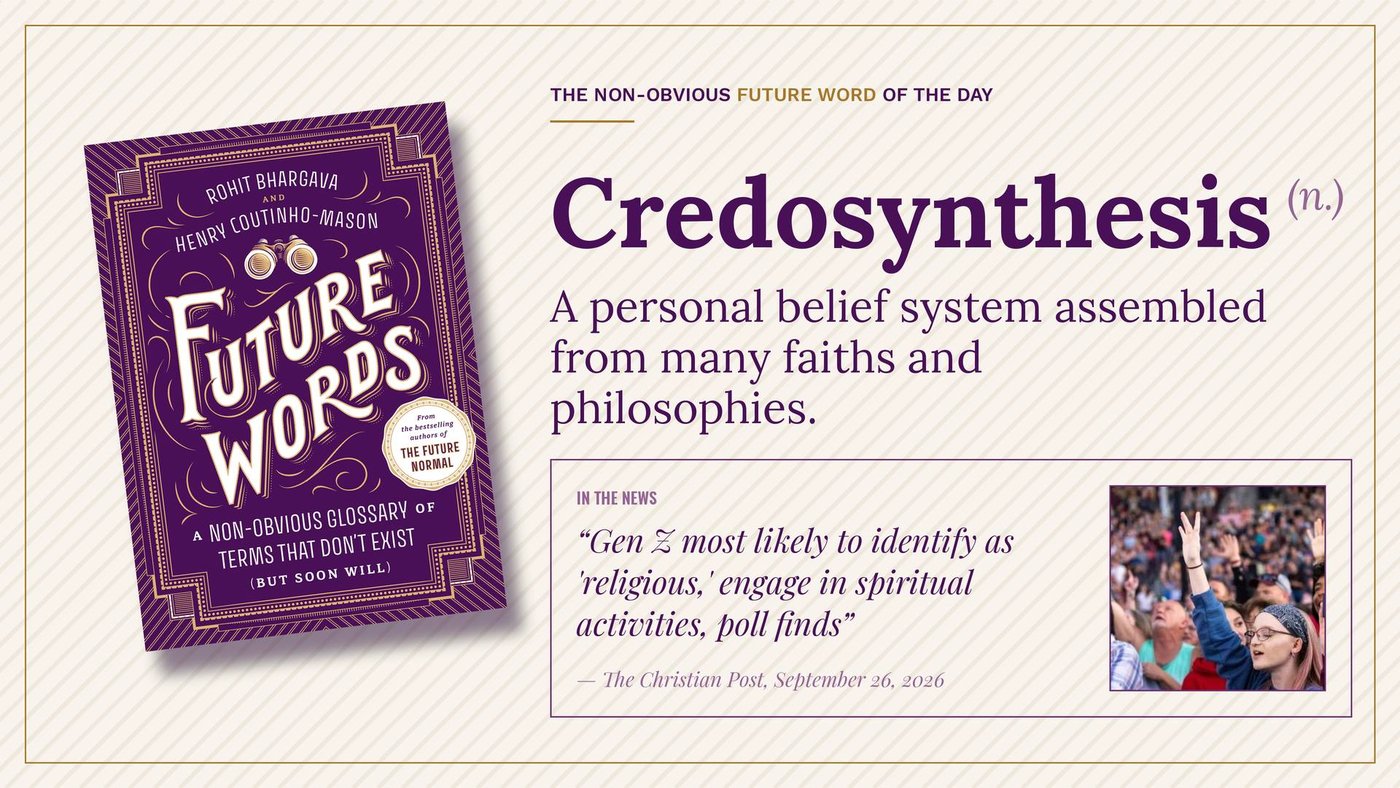
In Future Words, we introduced a term we called "credosynthesis" to describe exactly this idea that religion and belief systems themselves are slowly evolving with the younger generation to become a blend from many different sources rather than built from a single scripture as they may have been in the past.
