Your Digital Entourage, Angorithms, Boring Light Switches and Reverse Centaurs
What’s In This Issue?
 Story 01Your Digital Entourage Might Save Your Life or Find Your Next Business Connection
 Story 02Why the Cancellation of the GHC Matters For the Future of Tech
 Story 03The Case for Boring Light Switches
 Story 04Angorithm
 Story 05The Reverse Centaur's Guide To Life After AI
Even More Stories
- Cool chemistry trick allows new tattoos to 'turn on and off'
- Boston Dynamics testing whether robotic hands actually need pinkies
- AI Let a Dead Man Speak to His Killer in Court. Now the Sentence Has Been Thrown Out
- Finland to organise Festival of Nature Listening, dubbed ‘Quietchella’
- The First Fully AI-Generated Film Opens In Theaters In December, and Hopes To Make A Run For An Oscar Nomination
Media Recommendation
 PAPER
Your Digital Entourage Might Save Your Life or Find Your Next Business Connection
For 100 days, tech reporter Victoria Song tried a digital health twin from a service called Twin Health. The service included devices, an app and a suite of habits that encourages you to keep your digital twin up to date on all the things you do, eat and drink in the real world. Sometimes it can do that automatically too. In return, the digital twin offers a visualization of exactly what you should do based on your behavior to maintain or optimize your health.
"My digital twin isn’t so much a robotic clone as it is an AI-powered, color-coded food database that predicts how my glucose levels will react to everything I eat. Red is not so good. Orange is so-so. Green is ideal. It’s built based on the data I feed it, as well as data collected from a continuous glucose monitor."
Cheerios for breakfast? No problem, just walk an extra ten minutes right after to equalize your blood sugar. Motivation, habit formation (and retention) and actual health results are all being reported by those who are trying the technology. This is described by some as "metabolic coaching" - like an on-demand nutritionist who already understands your body chemistry and can predict with decent accuracy exactly what eating certain foods or at certain times is likely to do. In the future, experts hope this sort of metabolic twin might also help predict the effects of some types of medication without having to use your own body for testing.
Last week I also saw an engaging video of people actively wading through polluted rivers cleaning garbage along with a caption asking why we have robots making music or running races instead of figuring out how to do this job instead of people. Similarly, if we can make digital twins that can work pervasively in the background under our control to help us get or stay healthy, why not spend more time creating that instead of trying to digitize the likeness of Hollywood personalities to "act" in their place?
Our digital entourage may be able to do more than just track our health, though. Consider the recent story of the tech founders who gathered their AI agents to have a dinner party and to make social or business connections together simultaneously while their human counterparts were aiming to do the same next door. This is one version of the future, where we will all show up everywhere with our digital entourage in tow ready to make the healthy choices we can't and create the connections we don't.
I wonder how many of us would welcome that and how many would avoid it?
Why the Cancellation of the GHC Matters For the Future of Tech
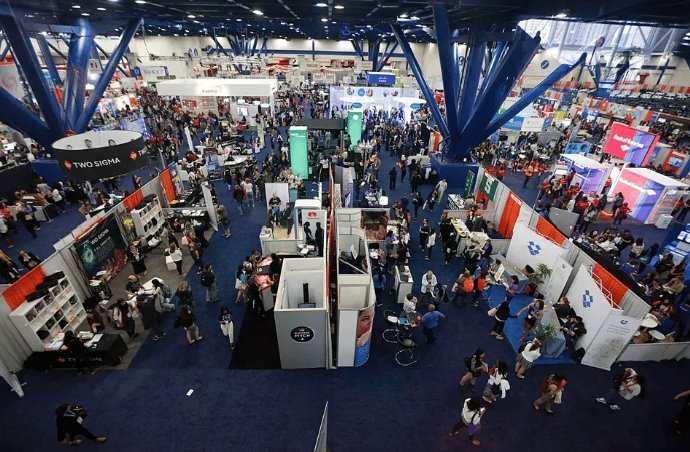
In November last year I was invited to speak at the Grace Hopper Celebration, widely described as the "world's largest gathering of women in tech." The annual event attracts more than 30,000 women working across the tech sector and unlike most tech conferences, is predominantly female. For example, CES is twice as large and usually attracts an average of only about 20% females. At GHC last year, the vibe was very different. The hallways were filled with women working at all levels of tech, not just the bosses, and the energy was full of optimism.
Most impressive to me was the scope of the event. From the many sponsors to the companies willing to send dozens of their female employees to the show. There were organizations traveling as groups to meet others, and people who had been coming for years reconnecting with old friends. Most of all, for once in a sector that is almost always male-dominated, there was a place that was specifically for women. It seems that somehow that support collapsed.
Now that it has been cancelled this year because "both individual registrations and sponsorship commitments came in significantly below our expectations." My friend Sandy Carter had a good perspective on what this news means for women in tech and one of the biggest impacts is likely to be the lost opportunity for networking and connections that would have happened there. She writes:
"The cancellation creates a test for GHC’s corporate partners. Some of GHC’s corporate sponsors include Capital One, CVS Health, Disney, Goldman Sachs, Google, Intuit and Morgan Stanley. Will they keep investing in ways to reach and support women in technology, or will those efforts disappear with this year’s event? For companies working to build AI teams, that question has strategic weight."
Across my social media feed, there were women expressing frustration, shock and sadness. Plus, the cancellation is leaving questions that are bigger because of what the show represents. I'm not a woman or someone working in an industry that often fails to recognize my perspective. However, as a speaker who was lucky to be part of the GHC stage once, I know what this gathering means.
Anitab's Annual Grace Hopper Celebration was a unique thing in the world of tech, and if another program (or series of events) cannot step up to take its place, something really meaningful will be lost. Having more female perspectives in technology makes it better for everyone. That was the truth I saw celebrated in every conversation at GHC last year, and a conversation I hope will carry on in whatever events come up next to keep the flame alive.
The Case for Boring Light Switches
October is busy season for conferences which means every week I'm staying in at least one hotel and sometimes more than one in different cities, so I do what most frequent business travelers do ... take a picture of my hotel room number so I don't mix it up from the night before. We all have these sorts of hacks to make it easier to be a road warrior. There is also a list of familiar travel gripes that you'll often hear when several of us get together, and often the light switch comes up.
There are always hotels designed by someone to be so elegant that finding the right light switch becomes an unwanted evening crusade. Often, it's nowhere near the lights. Sometimes, the nightstand has no switch at all, you just tap the light. Or the base. Or double tap. The worst designs are voice activated, which no one wants. This is an unnecessary game. I'll admit, I was triggered by an article in the NY Times this week suggesting that perhaps your light switches are boring and showing some flashier alternatives. Maybe there are. And at home, more creative liberties with light switches would certainly be an understandable "fun upgrade."
In hotels, the opposite should be the standard. Finding and flipping a light switch should be a thoughtless movement. Sometimes being customer centric and well-designed means being as boring as possible too.
Angorithm
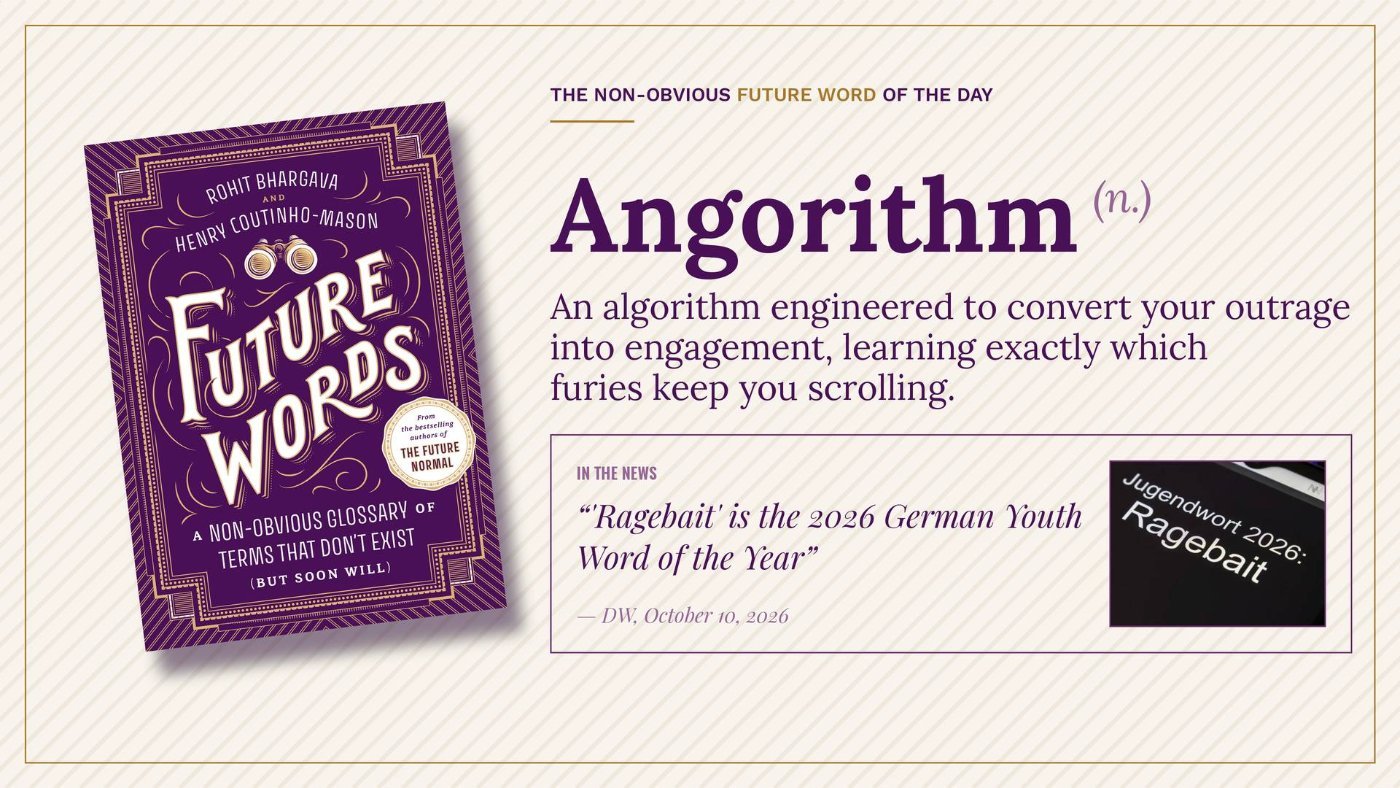
This past week at the Frankfurt Book Fair, "ragebait" was announced as the 2026 Youth Word of the Year. The term refers to "social media content that is deliberately designed to make people angry, frustrated or morally outraged." It is a word that has often come up in the media right now as we head into election season here in the US. There is a daily stream of ragebait out there.
It is interesting, though, that you'll rarely see any sort of mention or discussion about why ragebait has become so unavoidable. People have always been able to share inflammatory thoughts and are regularly in disagreement with one another. Twenty years ago, controversial blog posts got hundreds, if not thousands of angry comments. Yet most people were not living in a constant state of rage, feeling triggered at every moment.
Today, we are and it's not because ragebait exists. Ragebait spreads because of the angorithm. That was our Future Word to explain the rise of ragebait. Without the algorithmic amplification of rage-inducing content, it would not so easily spread to every corner of the Internet.
The Reverse Centaur's Guide To Life After AI
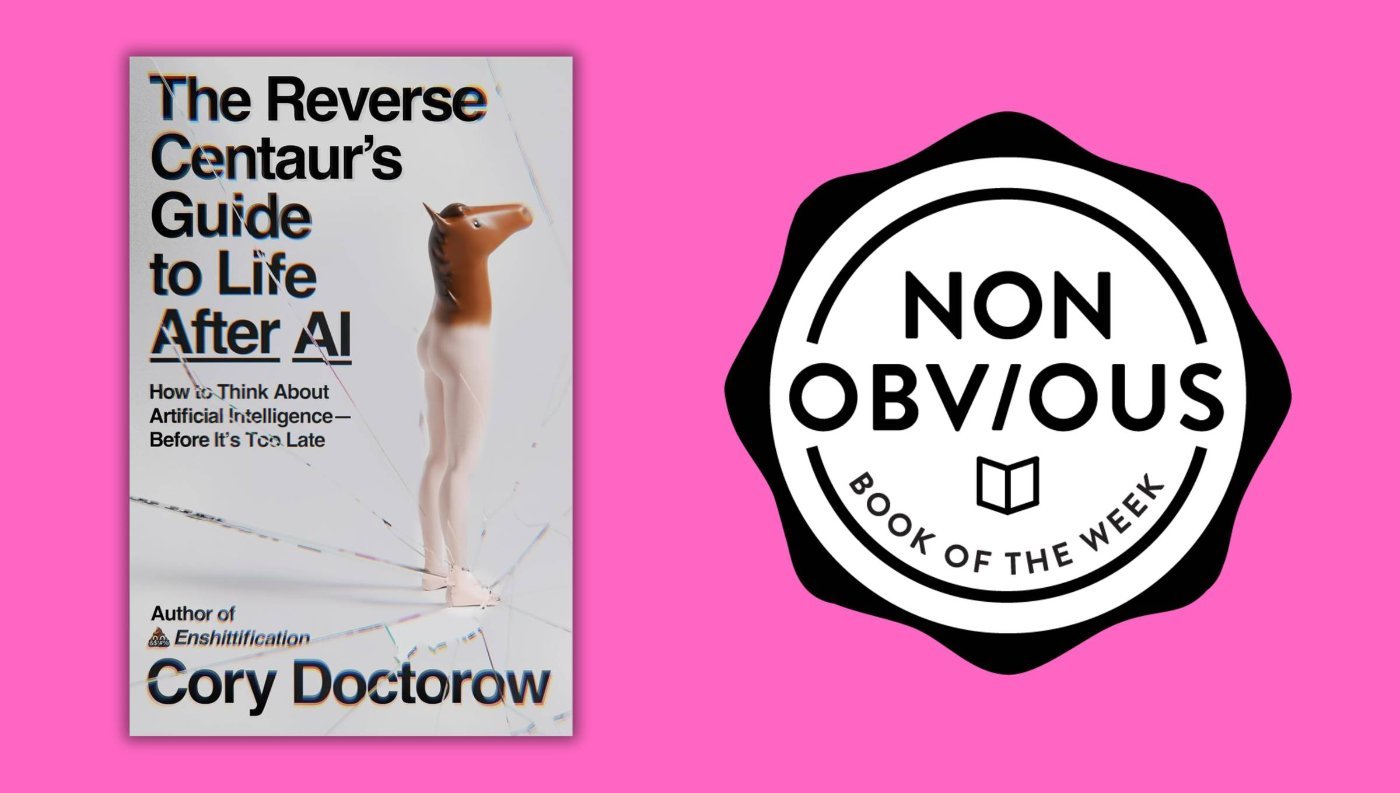
"In automation theory, a centaur is a person who is assisted by a machine ... Riding a bicycle or driving a car makes you a centaur. A reverse centaur is a human who is conscripted into acting as an assistant to a machine."
Thus begins the premise for yet another entertaining book from Cory Doctorow that dissects the fundamental battle we are all facing when it comes to the usage and over usage of AI in our lives. More importantly, it spotlights the choices we will make along the way, and perhaps some we already made unknowingly to send us down a path of docilescence.
That's not to say the book's scope is limited to tech-human interaction. There is an exploration of the "weird math" that allows for exponential valuations, how growth became more important than anything else for tech bros (including actual human safety), whether AI "art" is actually a thing and why "Agentic AI" may be the cleverest ruse from the tech industry yet.
Ultimately, this is a book that does what Doctorow is best at. Pulling back the curtain from the wizard and showing exactly how the sausage of tech is being made while proving incrementally what it should really be worth, and illustrate why the shiny future you are being promised will actually be significantly "enshittier" than advertised.
A sobering and worthwhile criticism of the hype and reality of AI worth reading and sharing.
The Non-Obvious Media Recommendation of the Week: PAPER
Non-Obvious Thinkers have a broad media diet. Every week I share a new website, magazine, newsletter, podcast, TV show, movie or other media source that can inspire you to see what others miss. Here is a summary of this week's pick:
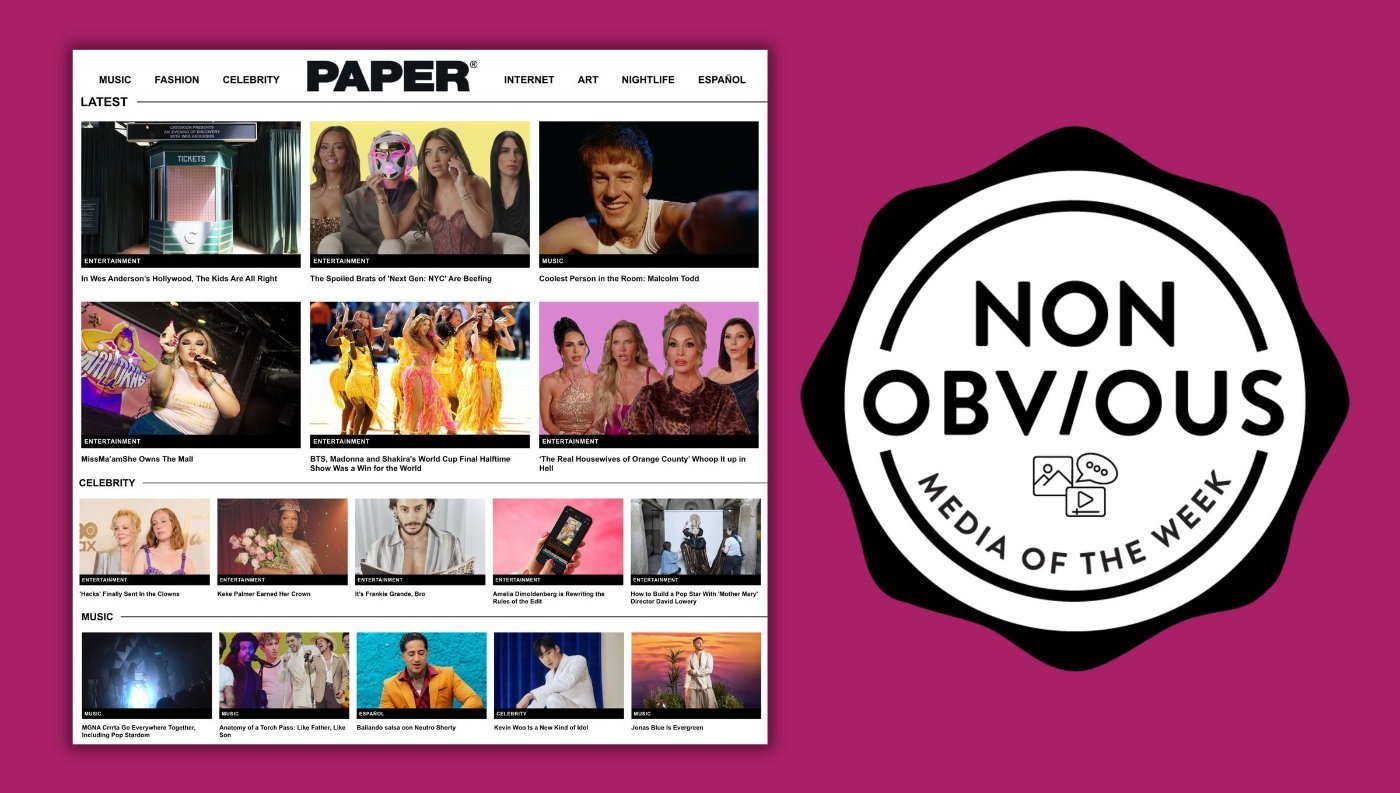
Paper Magazine has been on the front lines of New York culture for more than 40 years. It has taken on new ownership, reinvented their focus and remains an interesting combination of coverage on fashion, popular culture, nightlife, music, art, and film.
Truthfully this magazine and online site can feel a bit too pop, extra glossy and sometimes overly gossipy to really seem like it could offer much insight ("Your Favorite Model's Favorite Model!"), but the stories here can sometimes offer a nugget of something interesting that you hadn't seen elsewhere. Worth considering in your media diet.
