The Depolarization Project, a Literary Prize For AI Books and How Elections Really Work
What’s In This Issue?
 Story 01Introducing 25 Days of Non-Obvious Book Recommendations
 Story 02Inside The Depolarization Project and Deep Canvassing
 Story 03The Tokyo Experience That Lets You Feel Like You're Back In the Womb
 Story 04French Uber Drivers Find a Hack To Make More Money On Uber Deliveries
 Story 05Mnemophobia
 Story 06America, Let Me In
Even More Stories
- Wondering How US Elections & Voting Actually Works? This Michigan Website Aims To Explain It All
- Solar Panels Are Now Producing So Much Power That They’re Leaving Nuclear Plants in the Dust
- Europe's fastest-growing power plant is a solar panel renters clip to the balcony and plug into the wall
- Anthropic’s 97-page list of business risks is quadruple the length of other AI IPOs. What’s on it: Weapons, blackmail, and more
- Foreign tourists are flying into China with empty suitcases - and the reason flips the 'made in China' stereotype on its head
- Tech News Outlet Rest of World Faces Shutdown After 6 Years
- Colorado opened North America's largest wildlife overpass — and animal collisions fell 91%
- A rival luggage brand hired the DJ who torched his own suitcase — and gave him the title “Chief Destruction Officer”
- France launched the first literary prize for AI-written books — while every other prize is busy hunting AI down
- Join me to celebrate Diwali here >>
Media Recommendation
 The Gist
Introducing 25 Days of Non-Obvious Book Recommendations
My life is filled with books right now, more than usual. We launch Future Words in just a few weeks and in early December we will announce the winners for our Non-Obvious Book Awards. Along the way, I wanted to do even more to celebrate books that have changed the way I think and might do the same for you. Over the past month I've been curating a bunch of lists of my favorite book recommendations including mostly titles from my own bookshelf, combined with a few new books that were just released this year. Every day I will release a new list and the first several are already live. You can visit this page to see ALL the lists including the upcoming ones and let me know if you have any suggestions to add.
Inside The Depolarization Project and Deep Canvassing
Launched by a website called Reasons To Be Cheerful, the Depolarization Project is a compilation of stories that are around a single topic: we are not as polarized as people think. And we don't need to be. Described as "an experiment in curiosity," the landing page features multiple stories about how people are conquering division and finding a more human way to connect with one another, despite political differences. One recent story focuses on the effectiveness of deep canvassing, a process that involves meeting people face to face to shift perspectives.
The underlying purpose of the project is to demonstrate that we may not be as far apart in what we think as the media we consume might suggest. It demonstrates exactly how the angorithm drives us apart and why more discussion and an open mind could be the secret to not just being more cheerful but maybe changing our world too.
The Tokyo Experience That Lets You Feel Like You're Back In the Womb
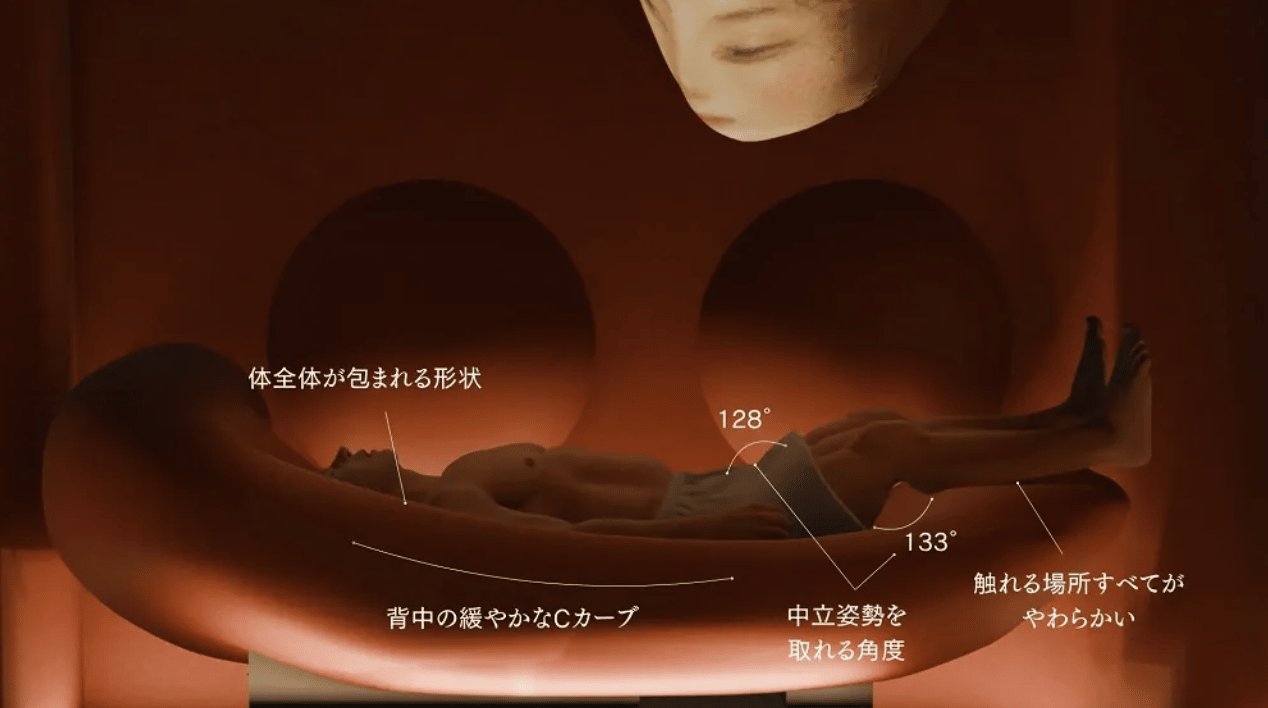
Do you remember what it felt like to be in the womb? If you're like most humans, probably not ... but it was probably pretty good. And now you can go back to it. A new experience in Tokyo is promising to make you feel reborn by returning you to the warmth and comfort of the womb. The experience is called the Sauna Mother and promises a place where you can "stop being an adult for two hours." Here's how the experience is described:
Sauna Mother takes customers all the way back to the prenatal stage of childhood. For example, instead of a regular old sauna, the facility has a Uterus Sauna, which reproduces the sensations of being in the womb through fleshy red lighting, muffled sounds, and a scent its designers say is evocative of the smell of a mother’s skin. You can even have your photo taken to be placed on your “rebirth certificate” that Sauna Mother provides. After emerging from the Uterus Sauna you’ll proceed to the Newborn Bath, a cold-water bath meant as an allegory to the initial rinsing of birthing fluids off of a newborn child. Subsequently, you’ll be warmed back up again in the Mother’s Lap Shower, for which guests are propped on a seat shaped like a woman’s torso and thighs. Finally, there’s perhaps the most visually impactful part of the experience, the Mother Sofa, where guests are cradled, rocked, and watched over. The goal of all this, Sauna Mother says, is to provide guests with “the sense of security they felt as newborns,” which will have them feeling invigorated when their session ends.
The cost for the entire experience? A two-hour session is listed for 8,500 yen (about $54). Looking at the photos of the experience, some elements are infinitely creepy (like the projections of motherly figures meant to "watch over you") but the entire idea is certainly non-obvious. I'll admit, I'm adding it to my own experience wish list for the next time I'm in Tokyo. When I do it, hopefully I'll emerge "feeling invigorated" and not suffering night terrors from memories of holographic mothers watching over me. Would you try this?
French Uber Drivers Find a Hack To Make More Money On Uber Deliveries
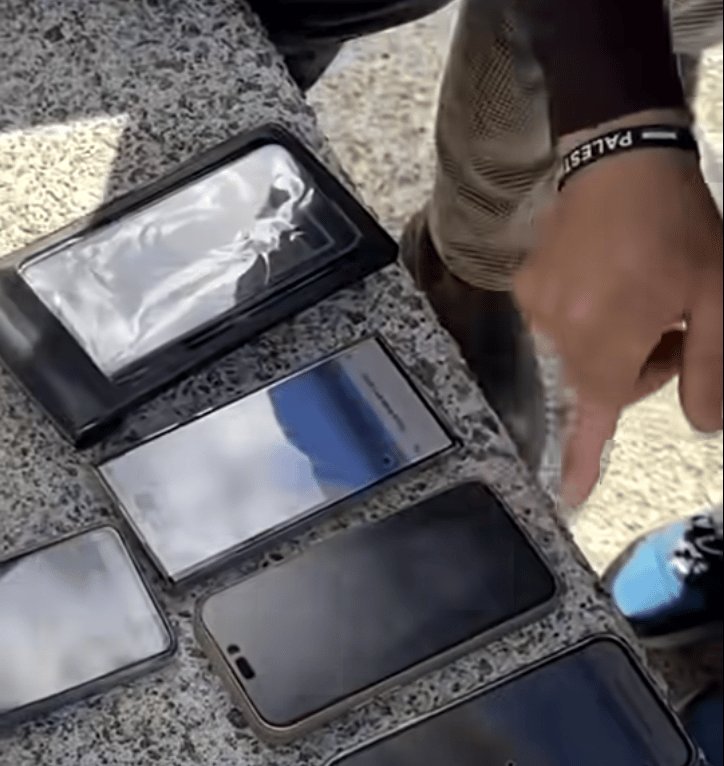
When the algorithm controls how much you get paid, it's probably inevitable that people will find a way to hack it. Since the start of ebay, people have been secretly using second accounts or friends to bid on their own products to drive up the price. The modern version of this is allegedly happening in France where videos emerged of Uber delivery workers using multiple phones to decline low paying delivery orders until the platform raises the compensation. The behavior, obviously, is banned by the app and any workers caught doing it are banned from future work ... however many are sharing the story as an example of the little guy finally fighting back.
As dynamic pricing becomes common, this is one of the responses we are likely to see more of. When consumers start to understand how pricing works, they will adapt their behaviors to try and land a better deal. Similar to the common last second search for an online discount code before clicking the "buy" button, this is a learned response and one we touched upon in coining our future word "dealusion" (the ongoing suspicion, fueled by dynamic pricing, that there was always a better deal than the one you got). Forecasting toward what may come next, the skill to do this may itself become one in demand and worth paying for. Or perhaps it will fall to agents. AI deal hunting is already an emerging category. I'm curious if many of you are already doing this. If you're using AI (or an actual human) for this sort of assistance, hit reply and let me know.
Mnemophobia
This is probably not a newsflash for you, but people don't generally like being surveilled. It's the reason for widespread backlash against tracking and surveillance tools right now and also one of the reasons why the Muse glasses have been such a flop. More than the criticism of these "pervert glasses," there are now tools emerging to help people identify when they are in the presence of these tools and protection to circumvent being recorded too.
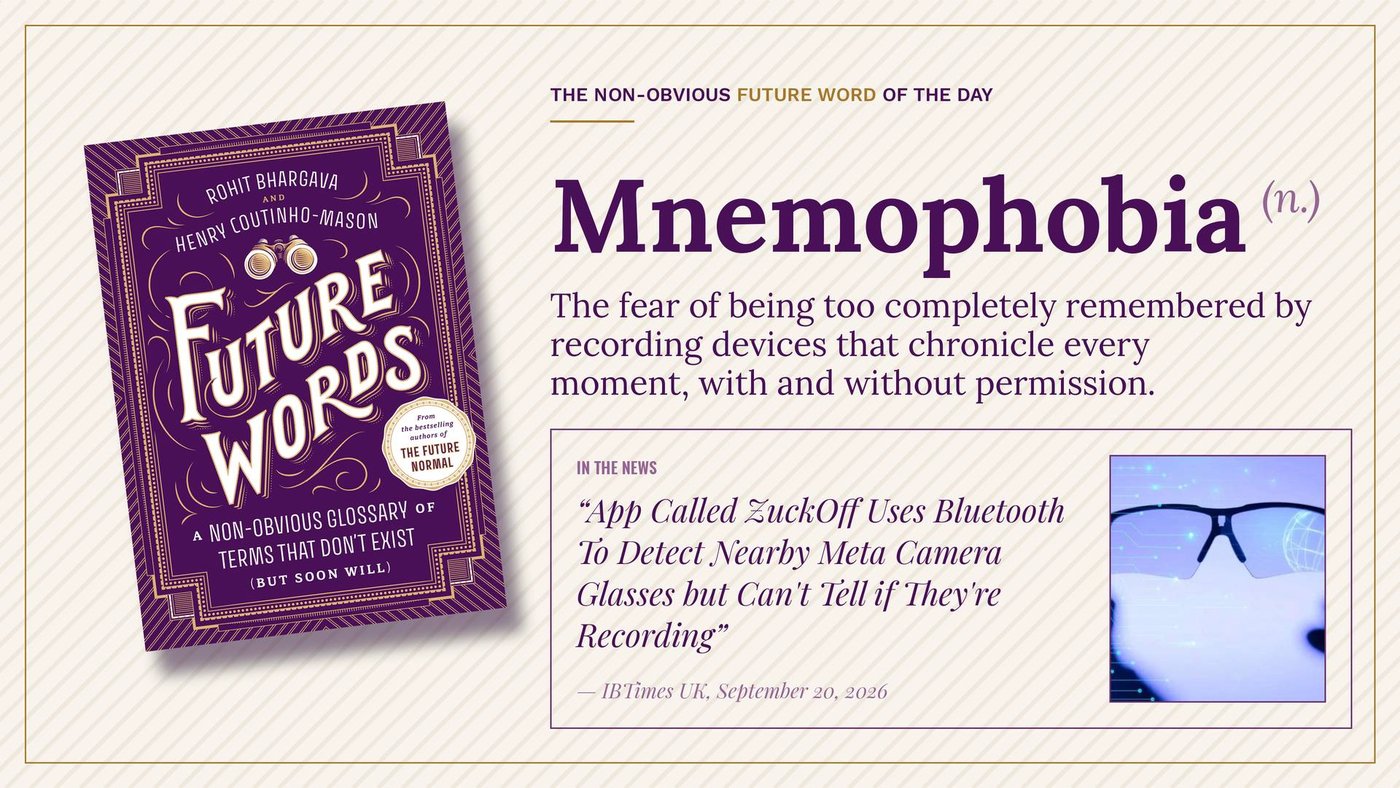
A story emerged this week of a new app entertainingly called ZuckOff that uses bluetooth to detect if there are Meta camera glasses active nearby. This is a backlash we anticipated and aimed to name with our future word - mnemophobia defined as "the fear of being too completely remembered by recording devices that chronicle every moment, with and without permission." The word was inspired by Mnemosyne, Greek goddess of memory and mother of the Muses. While this used to describe a fear of memories themselves, now the dread is not the past, but the disturbing reality that nothing in it can be forgotten (or even misremembered fondly) anymore.
The idea of recording devices is one aspect of the word, but the other is related to our ongoing habit of sharing social media content about our lives and personalities. All of it builds a social graph of our personality that becomes nearly impossible to erase over time, and central to who we see ourselves to be. The challenge comes when you are in a moment of reinvention or hoping to shift from who you were to the next phase of yourself. The digital footprint may be holding you back from that evolution, and this more than anything else is the fear that we felt the term mnemophobia really described. Is this a fear for you? Hit reply and let me know what you think.
America, Let Me In
Yesterday was National Immigrants Day, as declared by US President Ronald Reagan back in 1987 to coincide with the 101st anniversary of the Statue of Liberty's unveiling. It has become a loaded topic in countries around the world as politicians and citizens alike encounter daily stories about the contributions and value of immigrants to their chosen homes. Here in the US, the data itself is clear. Immigrants make up roughly 19% of the total U.S. workforce, foreign-born individuals account for 23.6% of all entrepreneurs and nearly 46% of 2026 Fortune 500 companies were founded by immigrants or their children.
On the eve of the midterm elections here in the US, I thought I'd share a bit more of a lighthearted read around a serious topic. As a former writer for the Late Show with Stephen Colbert, Columbian-born Felipe Torres Medina brings a comedian's voice to the topic in his book written in the style of a Choose Your Own Adventure story. The book starts with a question to the reader about whether you want to come to America the easy way, the medium way, the hard way or the very hard way. The stories progress from there.
The clever part about the book is that it illuminates the many actual paths that immigrants can take to come to America along with the challenges associated with each. From the difference between an I-526 and an I-829 form to the systemic inequity built into the system in how immigrants from one region are treated versus another - the book packages insight with humor to offer a rare inside look into how immigration actually works. For anyone who wants to get inside this tricky issue in an approachable way: America, Let Me In is my pick for this week's Non-Obvious book of the week.
The Non-Obvious Media Recommendation of the Week: The Gist
Non-Obvious Thinkers have a broad media diet. Every week I share a new website, magazine, newsletter, podcast, TV show, movie or other media source that can inspire you to see what others miss. Here is a summary of this week's pick:
The GIST is a fan-first sports media brand that's shaking up the male-dominated sports industry. We're reinventing the dialogue around sports by providing equal coverage to women's and men's sports. The GIST is all about changing the game in the male-dominated sports industry where less than 15% of journalists are women and less than 5% of coverage is on female athletes and non-binary folks.
